Anaklia, the town that waits

On the edge of Abkhazia, a resort built to dazzle has become a ghost town. Futuristic ruins, three thousand years of history, and the idea of a port that, perhaps, is finally about to become real.
You'll see
It's an April afternoon and we've just got back from a walk along the Jumi river, a few kilometres outside the centre of Zugdidi, where we're spending a week as guests of Georgii's father's family. It's a beautiful sunny day and there are still a few hours left before sunset: we have the car, and I'm craving the sea. I open Google Maps for a bit of inspiration, scroll through the places I'd saved over the previous days, and stop at one name: Anaklia.
I ask Georgii what he thinks. He takes a few seconds to answer. Then he says yes, it could be interesting, if only to see whether there have been any developments since he was last there, a couple of years ago.
“What do you mean, developments?”
“You'll see.”
The satnav says thirty-eight minutes. The road runs between fields and woods, with the obligatory piglets trotting along the verge and cows either ambling across at their leisure or sprawled out on the roadside like they own the place, utterly unbothered by the traffic. After ten minutes or so heading towards the Black Sea, the first signs for Anaklia appear, and that's when I notice a detail: unlike almost everywhere else we've been, here the name is always written in the Latin alphabet too. A clue. Someone, at some point, was expecting visitors from far away.
The closer we get, the tidier the road becomes: pavements, street lamps, roundabouts, infrastructure designed for a great flow of people. And yet something feels off. Everything seems to be waiting, or quietly falling apart.
A promenade for no one
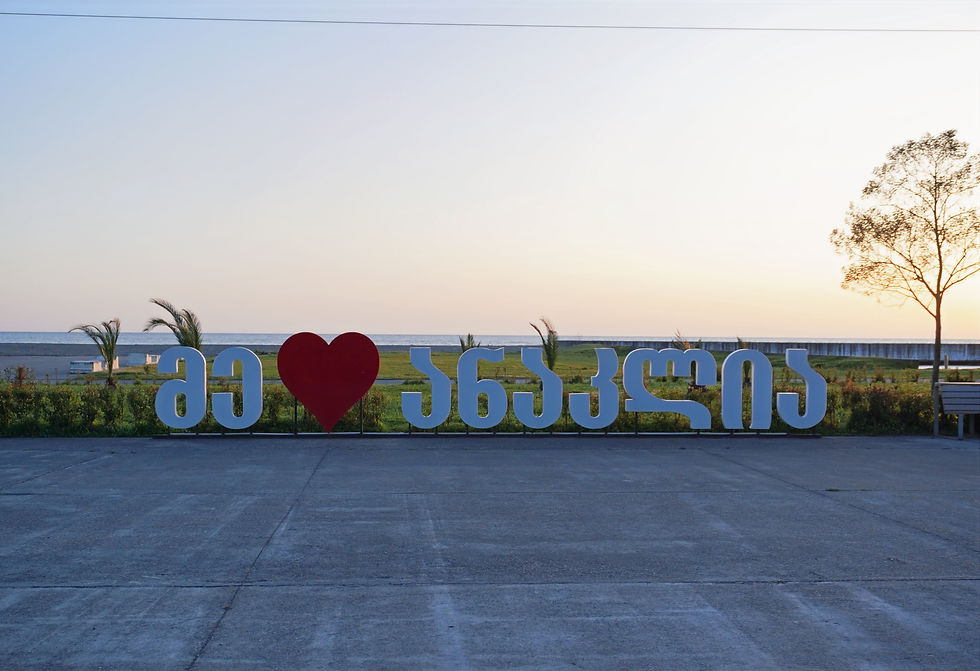
Then the town sign and, a little further on, visible from the car window, the words “მე ❤ანაკლია” (I ❤ Anaklia) framed by palm trees and the beach behind. It's the moment I park that I understand what Georgii meant: we've arrived in a ghost town.
We stop in front of a large, crumbling building. Two or three men in builders' clothes are standing outside, and I wonder what they could possibly be doing at an abandoned block. The tarmac is split open by roots, the road markings faded almost to nothing.
The seafront, on the other hand, is beautiful, and that's exactly what makes it unsettling. A promenade lined with palms and benches facing the water, a beach fully kitted out with showers, toilets and children's play areas. The only thing missing is people. On the opposite side stand hotels, bars and restaurants with futuristic architecture, shapes designed to impress, yet completely abandoned, eaten away by the Black Sea salt. Along the wide beach, eccentric towers rise up, their top floors hinting at restaurants with breathtaking sea views. It all stays in the imagination: the buildings are dark, empty shells.
We walk with only the stray dogs for company, and here they seem to rule not just the road but everything that rises from the ground. On the horizon, the Caucasus watches the scene, unmoved, as if it had seen this decline coming.

A bridge from Franconia
The promenade leads us to the bridge, which I'd read is one of the longest timber footbridges in Europe: around half a kilometre of wood and steel cables spanning the Enguri to link Anaklia with the village of Ganmukhuri on the far bank. Its lines are clean and modern, and at night carefully placed lighting picks out its full length.
Its story captures the spirit of those years perfectly. The masterplan called for a grand steel suspension bridge, but it was far too expensive, so the project fell back on timber. The client, however, wouldn't give up on the drama of the cables, so the German engineers at Leonhardt, Andrä und Partner designed a hybrid: a series of glulam timber spans plus a small cable-stayed section with a steel pylon. Georgia had no shortage of wood, but it lacked the expertise and the factories to work it on this scale. The beams were made in Lower Franconia, in Kleinheubach, in thirteen-metre sections, and driven by lorry across the Balkans and Turkey. The steel came from Ukraine, the cables from Italy. And when, during assembly, the client saw the bare truss and fell in love with it, the decision was made not to clad it in chestnut as planned, but in transparent polycarbonate panels, so that it would stay on show.
Opened at the start of 2012, it now bears the marks of salt and wind, but it's still standing: Anaklia's most photographed landmark, and perhaps its perfect summary. An ambitious piece of work, built for a future that never turned up.
Three thousand years before the resort
At first glance, I'd assumed Anaklia was a visionary project that had sprung up from almost nothing, or rather from a stretch of coast that had always been empty. But digging a little deeper, I discovered that this strip of shore at the mouth of the Enguri has actually been inhabited for at least three thousand years. The first settlements date back to the Middle Bronze Age and belong to the culture of Colchis, the legendary land of the Golden Fleece. Classical authors called it Heraclea and, in the seventeenth century, travellers such as Jean Chardin recorded it as Anarghia.
After the Kingdom of Georgia fragmented in the fifteenth century, Anaklia became a fortified town, port and fishing centre of the Principality of Mingrelia, the realm ruled for centuries by the Dadiani, the family behind the famous palace in Zugdidi. In 1723 it was taken by the Ottomans, who turned it into a maritime outpost and a slave market, and built a fortress whose ruins still survive. The Russians arrived in 1805. By the mid-nineteenth century it was a small fortified port, with a customs house, regular trade with Turkey and suburbs home to Greeks, Jews and Armenians.
In Soviet times, Anaklia was a minor base of the Black Sea Fleet. Then the war in Abkhazia in the early 1990s turned it into frontier land: from 1994 a Russian peacekeeping post set up inside the walls of the old fortress, was accused of damaging it, and only left in July 2007, after Georgian protests.
Port, frontier, outpost. Anaklia has always inspired dreams of greatness.
The dream of Lazika
The latest of these dreams has a first name and a surname. In 2010, Mikheil Saakashvili's government decided to fast-track the development of Anaklia and neighbouring Ganmukhuri, building the resort, its design hotels, the promenade and the bridge. At the end of 2011, Saakashvili unveiled Lazika: a brand-new city to be built a little further south, a free economic zone with a deep-water port, planned to become Georgia's second city and home to half a million people.
There was a political meaning too, and you can sense it from the seafront. Anaklia was meant to be the new government's showcase and, in a sense, to make up for the loss of Sukhumi, the Riviera lost in the war of the early 1990s, just across the river.
Then, in October 2012, Saakashvili's party lost the election. The new Georgian Dream government, determined to distance itself from its predecessor, froze almost all of his projects, Anaklia included. Lazika was never born, and the vast resort building site quickly turned into a landscape of modern ruins, as photographed by Rafał Milach in 2013.
The port, on the other hand, never quite left the stage. In 2016 it was handed to a Georgian-American consortium, and in December 2017 construction was launched with great fanfare.
In January 2020 the government cancelled the contract, amid mutual accusations of delays and sabotage and an international arbitration that only concluded in 2024. In May of that year a new partner was chosen, a Chinese-Singaporean consortium. In between, for a few summers, Anaklia lived off electronic music festivals, which filled the beach with colourful tents for a couple of weeks before leaving it empty again.

Summer 2026: the dredgers arrive
When Georgii talked about “developments”, this was the possibility he had in mind. And 2026, unexpectedly, turned out to be the year something actually moved.
In those very weeks of April, Prime Minister Irakli Kobakhidze announced that work would resume, with costs cut by more than a quarter. Then in July came the twist: the Chinese consortium, which in two years had never signed a binding agreement, pulled out, and the government announced that the state would build and own the port itself, under the so-called landlord model: public infrastructure, with terminals leased to foreign operators. In the background lies a bigger game, the Middle Corridor, the trade route between Asia and Europe that bypasses Russia.
In August, two dredgers from the Belgian firm Jan De Nul arrived off Anaklia, and are digging the channel and basin to a depth of seventeen and a half metres. Dredging is due to finish by December. But at the end of September the port still had no berths and no cranes, and the state budget for 2026 had been cut by two thirds. Things are stirring on the tourism front too: the Ministry of Infrastructure has announced a plan to regenerate the coast between Anaklia and Ganmukhuri and protect it from erosion, and there's talk once again of renovating the promenade.
It's hard to say what will come of it. A deep-water port could bring jobs and life back to a place that has had little of either for years. Or it could simply add another layer of promises to the ones already rusting on the beach. And the question remains: who will this new Anaklia be for? Container ships, tourists, or the people who live here?
The ship
Once across the bridge, on the far bank, the day's final image is waiting for us. Lying on the beach is a ship, the Morskoy Konik: an old metal hull devoured by rust, stranded between sand and pebbles a few steps from the bridge. We realise it didn't end up there by chance. It was placed there deliberately, like an installation, to create a romantic contrast with the modernity of the port project that was meant to rise next door.
Except the modernity never arrived, and the contrast is gone. Today the rusting ship and the abandoned futuristic buildings go hand in hand. They tell the same story: of a place that someone has imagined as a great port for three thousand years, and that carries on, patiently, waiting.

We head back to the car as the sun sinks into the Black Sea. This time I don't ask Georgii what he thinks. The developments, it seems, are real: the dredgers are working, the ministers are announcing, the plans are being redrawn from scratch. Whether Anaklia will truly wake up, or whether in a few years we'll be walking along the same deserted promenade, nobody knows yet.
We'll see.

Comments