Learning Georgia Around an Easter Table

Updated: Jul 25
A Georgian proverb says, 'A guest is a gift from God.' I had already experienced its truth before this visit — two autumns ago in Tbilisi, when visiting Georgii's cousin and his family, and a few years earlier, during my first visit to Georgia with my family. But Easter week in Zugdidi took that truth to its fullest expression: a house was always open, a table that was always full, and a family who treated me less like a visitor and more like a family member.
What follows is an account of a family gathering and a side of Georgia that only opens up once you enter a home and join the table.
13 April 2026
Today is departure day.
My alarm rings at 4:45 a.m. to catch the morning flight from Milan Malpensa to Kutaisi. It is an early start, made slightly harder by the fact that less than twenty-four hours earlier I had crossed the finish line of the Milan Marathon. Breakfast at the departure gate is whatever survived inside the race pack: a banana, a packet of crackers and an isotonic drink, accompanied by a large, comforting latte macchiato.
Three and a half hours later, the landscape outside the window changes. Green hills replace the Alps, and I land at Kutaisi, where Georgii and his cousin are already waiting for me. Together we begin the two-hour drive west towards Zugdidi. Rain accompanies us for almost the entire journey.
Leaving Kutaisi behind, the roads become quieter and increasingly rural. Their condition also changes noticeably. Deep potholes interrupt the asphalt, demanding constant attention from me, the driver. Every now and then, cows decide that the carriageway is the most convenient place to stand and piglets trot confidently across the road. After about two hours, I finally read the sign I had been waiting for: ზუგდიდი — Zugdidi.
A few hundred metres later, Georgii's cousin leaves the main road and turns into a quiet residential street. We have arrived.
A House Built for Gathering
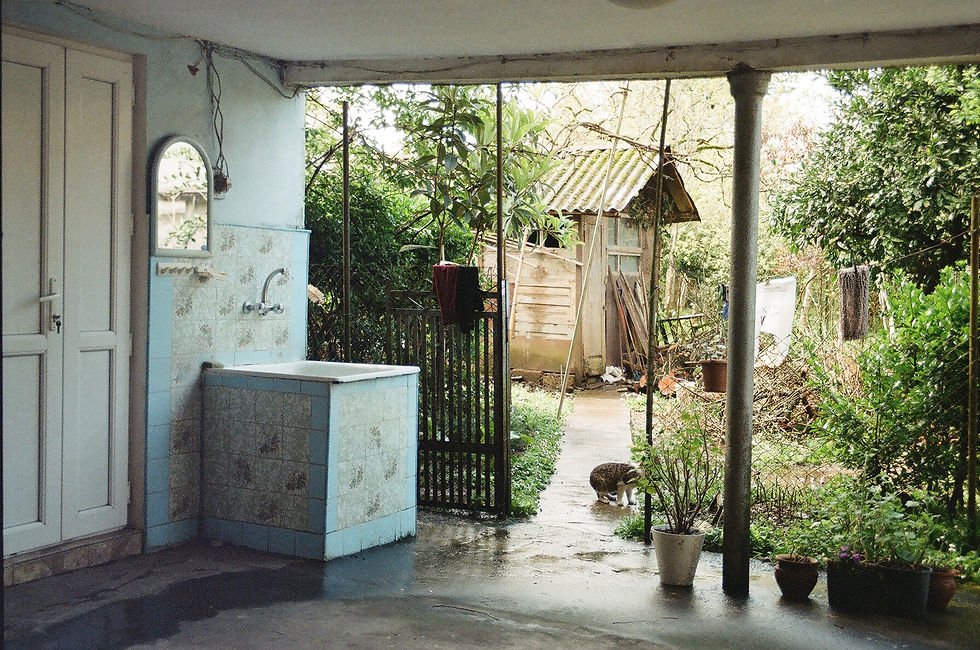
This is the house where Georgii spent every summer of his childhood, travelling from Saint Petersburg to visit his father's family. A generous garden surrounds the house. There is a vegetable patch, a chicken coop, citrus trees heavy with oranges and Georgian lemons, and feijoa trees. During this trip I taste feijoa (a fruit somewhere between pineapple and guava) for the first time. I have it mostly in the form Georgii's relatives prepare it: kompot.
Kompot is a staple, non-alcoholic fruit drink much liked across Georgia made by simmering fruit with a little sugar and water and serving it well chilled. The feijoa version is a small revelation: pale, faintly perfumed, carrying the fruit's own sweetness alongside something floral, almost minty. It becomes my drink of choice for the rest of the week.
The house unfolds over two floors. Downstairs are the kitchen, several bedrooms and a large dining room with a big wooden table. Upstairs, another spacious salon, furnished with massive wooden cabinets, another impressive dining table, and more bedrooms.
The house designed around hosting people. Throughout the week, relatives and neighbours drift in and out. Doors remain open, chairs are simply added to the table, and another place is found. The kitchen works almost without interruption. For five or six hours every day, pots simmer, vegetables are chopped, herbs washed, dough rolled, meat grilled and sauces prepared.
The Easter Table
When we arrive, the family is already gathered. Some neighbours have come by as well. After the greetings, I wash my hands and walk through the kitchen towards the dining room. Large pots steam on the stove, filling the house with delicious aromas.
Then I see the table. There is not a single empty space; it looks like a mosaic of colours and textures. There are mtsvadi (skewers of grilled pork), fresh salads of tomatoes, cucumbers and onions dressed with crushed walnuts, golden khachapuri, bowls filled with different kinds of tkemali (a plum sauce), baskets of fruit, homemade pelamushi (a dessert made by reducing grape juice before thickening it into a smooth pudding served with walnuts), carafes of red and white wine, homemade kompot and bottles of naturally sparkling Borjomi mineral water. And, of course, eggs: a large bowl of them, dyed a deep brick-red, set at the centre of the table.
Georgian Easter eggs are traditionally dyed using rubia, a plant also known as madder, which is boiled with the eggs until the shells take on a rich red colour. This carries an old legend: when Mary Magdalene told the Roman emperor Tiberius that Christ had risen, he's said to have replied that he'd sooner believe the egg in her hand could turn red than believe a dead man could return to life. According to the story, the egg turned red as he spoke, and the tradition of dyeing eggs at Easter has continued ever since.

Beside my plate there is smaller plate which gets soon filled with a generous spoonful of steaming ghomi, a white version of Italian polenta. I am encouraged to add slices of sulguni cheese while it is still piping hot. The cheese slowly melts into the thick cornmeal, stretching with every spoonful. Ghomi originates from the Samegrelo region, where it replaces bread at the table. Left unseasoned, it becomes the perfect companion for richly flavoured dishes, walnut sauces and grilled meats.
One by one I begin tasting everything. Like everyone else, I alternate happily between sweet and savoury. And then, the first toast is made. I quickly realise that dinner is only one part of what is about to unfold. The true centrepiece of the evening is what happens around it.
The Supra
It is known as the supra (სუფრა): Georgia’s traditional feast and one of the country’s oldest cultural practices, recognised by UNESCO as part of Georgia’s intangible cultural heritage. Whether held for a wedding, Easter lunch, birthday or another important occasion, each gathering follows a ritual shaped by customs that have been passed down through generations.
At our table we are about fifteen. At the head sits the tamada (თამადა), the toastmaster. Throughout the evening, he guides the rhythm of the meal, introducing each toast, deciding when one topic has reached its conclusion and when the next may begin. Before every toast, glasses are refilled. When the tamada begins speaking, conversations come to a halt. Only after the toast does everyone drink.
Toasts as Conversations
The first toast is dedicated to God and peace. The second to Georgia. Then come parents. Ancestors and those who are no longer with us. Children, the family. Each toast builds on the previous one, slowly widening from the individual to the collective, from memory to wish and good hope. The Georgian language even has a special verb for proposing a toast: dalotsva — დალოცვა, which literally means "to bless" or "to say a prayer." That linguistic overlap says a lot about how these moments are understood.
Often the Tamada concludes a toast by saying alaverdi — ალავერდი: an invitation for someone else to continue the thought before everyone drinks together. I find this beautiful: the toast belongs to everyone around the table.
A Cuisine Built Around Sharing
During the following days I begin recognising dishes as they return to the table in slightly different forms. The same meal never tastes exactly the same twice.
One dish quickly becomes my favourite: ajapsandali, a slow-cooked stew with aubergines, peppers, carrots, green beans. It is one of those recipes that becomes even better the following day. Georgii gave me his father's recipe and back in Munich I cooked it a first time and it quickly part of my culinary staples. Almost every weekend I cook a large batch for the week, sometimes eating it warm, sometimes cold with some bread over the following days. If you would like to try it yourself, I've included the recipe for ajapsandali at the end of this article.
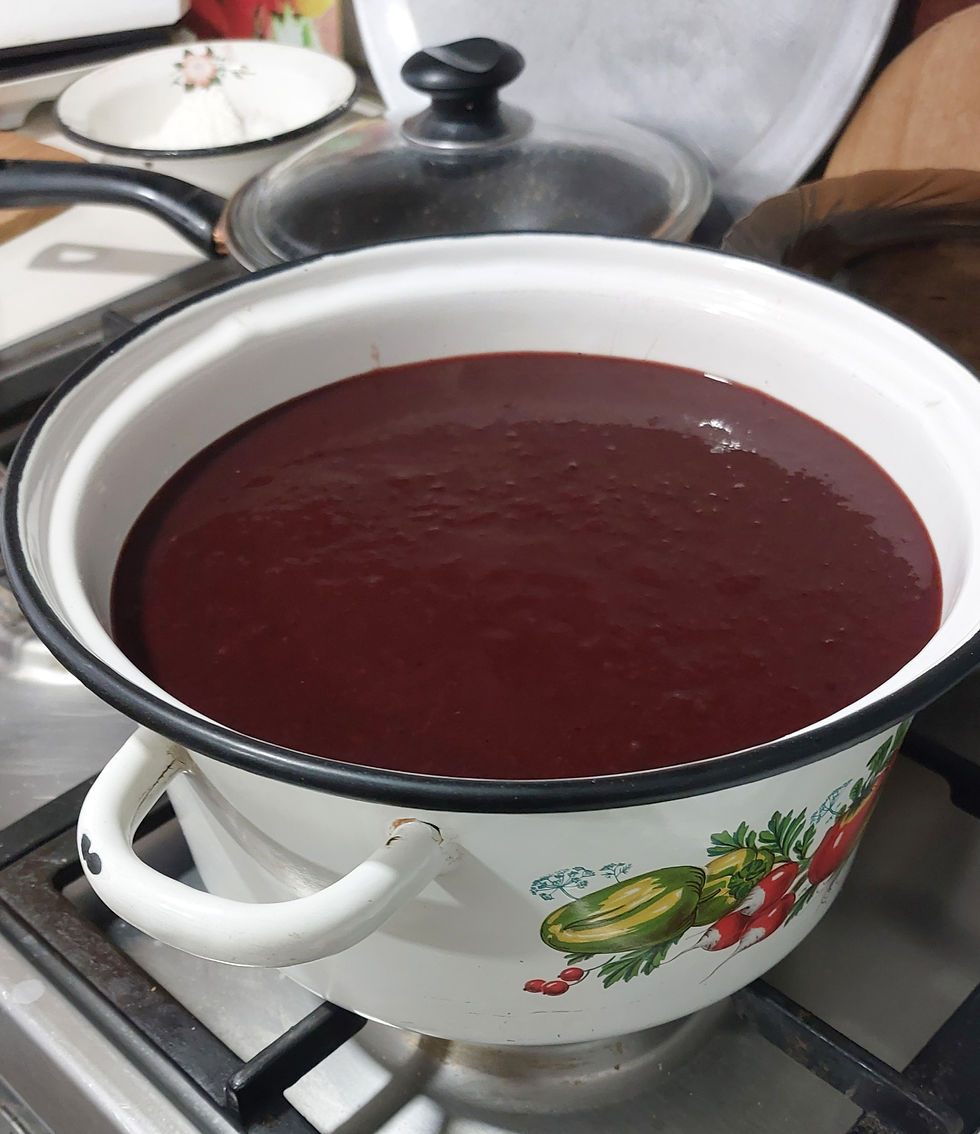
Another constant accompaniment is tkemali, Georgia's famous plum sauce. There are green versions made from unripe spring plums and darker red versions prepared later in the season. Both combine fruit with garlic, coriander, dill and herbs, creating a sauce that is quiet sour, aromatic and zesty. Georgii is a big fan of tkemali. On our last morning in Zugdidi we visit the local market with his aunt for one mission: buying enough tkemali to cover as many following months in Munich as possible. Before packing the bottles in our suitcases, his aunt opens the bottles with the tkemali from the market and recooks the sauce with her own spice mix. "Now it's ready," she says. Some recipes do not really belong to paper.
What I Carried Back
The days after Easter were quieter. Leftovers from the feast got reheated and rearranged, joined by a new dish that had been started that morning. Visits kept coming, and trips to nearby sites began.
I've been told about a custom that falls the Monday after Easter: families visit the cemetery, bringing red eggs, wine and food to the graves of relatives, lighting candles and setting up a small supra right there at the graveside. Some pour a little wine onto the ground for the person they've come to see.
For the a couple of days it was just the two of us with Georgii's father, uncle, aunt and her sister, and that quieter stretch let me time to observe the household: the harmony of meals timed as much around medication schedules as hunger, plates quietly weighted toward care. What stays with me most is the rhythm of the people living in the house: pots scrubbed, laundry hung, the vegetable garden weeded and watered. Time here gets shared out and folded into chores and conversation in the same breath, so that by the time everyone finally sits down to eat, the meal already carries the whole day's work inside it.
Recipe: Ajapsandali
Adapted from Georgii’s father’s recipe. Serves 4.
Ingredients
3–4 carrots, cut into 1 cm rounds
2 eggplants, cut into 2–3 cm cubes
300–400 g green beans, trimmed and cut into 3–4 pieces each
1 red bell pepper, diced
1 green or red chilli, finely chopped
2 large tomatoes
1 medium yellow onion, diced
3 garlic cloves, finely chopped
4–5 tbsp neutral oil
Salt, to taste
Your favourite spice blend for stews, to taste
A generous handful of fresh coriander, roughly chopped
Method
Heat the oil in a large pot over medium heat. Add the carrots and cook for 5–10 minutes, stirring occasionally.
Meanwhile, bring a small pot of water to the boil. Score the tomatoes lightly, place them in the boiling water for 2–3 minutes, then remove and peel them. Finely chop or crush them into a rough paste.
Add the eggplant, bell pepper and green beans to the carrots, followed by the prepared tomatoes. Stir well and cook for around 10 minutes.
Add the onion and garlic, then season with salt, the spice blend and the chopped chilli.
Reduce the heat, cover and leave to cook gently for around 45 minutes, stirring occasionally, until the vegetables are very soft and beginning to melt into one another.
Serve warm or at room temperature, finished with plenty of freshly chopped coriander.
And here you have the video of the recipe from Georgii himself:


Comments